Plymouth to Minneapolis Commute: Routes, Transit and a Homebuyer's Checklist
Compare driving and transit from a Plymouth home, including Metrolink routes, park-and-ride locations, Click-and-Ride, and the return trip.

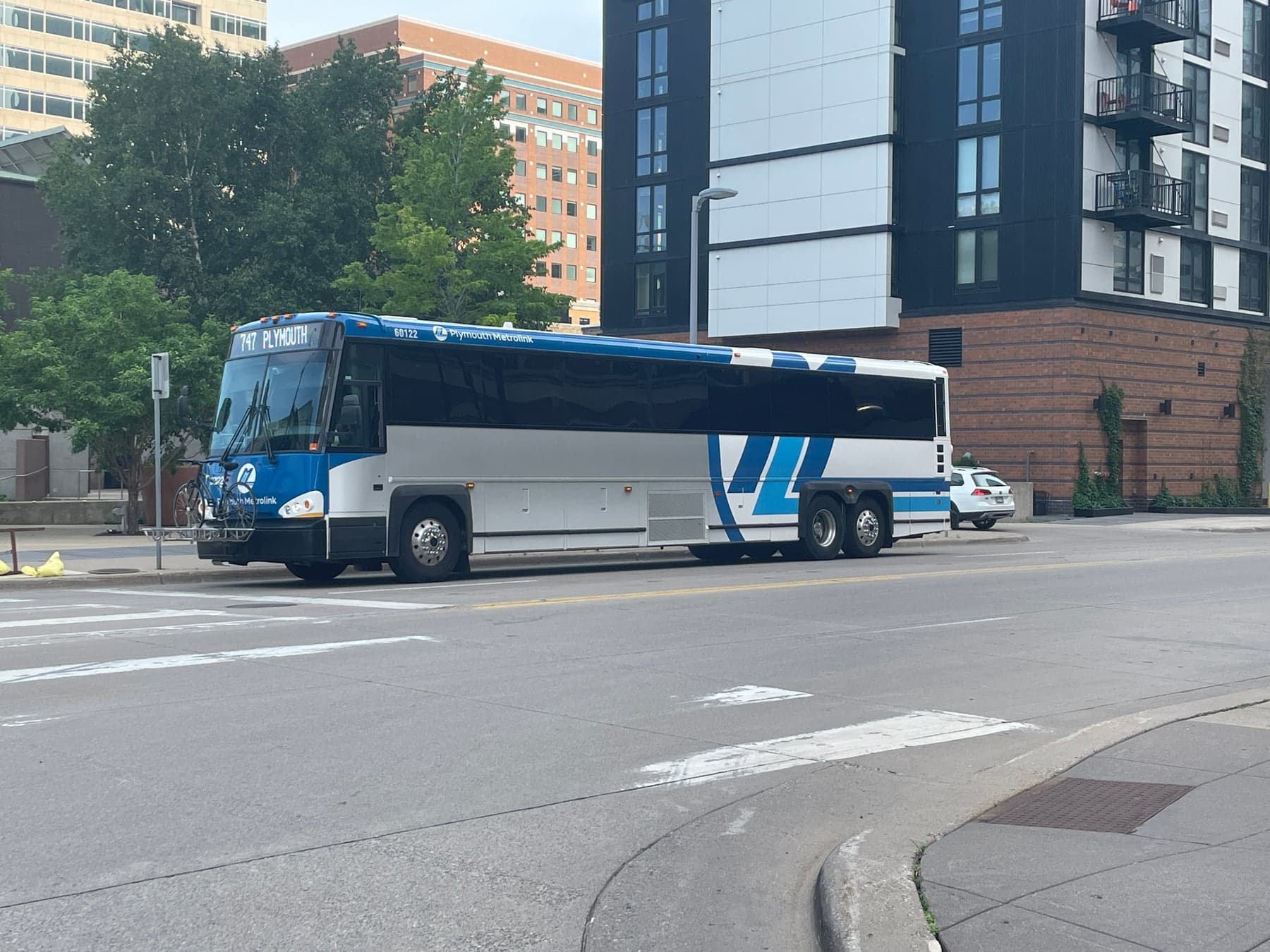
A Plymouth Metrolink coach displaying Route 747 in downtown Minneapolis at Marquette Avenue and South 11th Street, photographed in June 2023
Photo: Eóin · CC BY-SA 4.0A Plymouth-to-Minneapolis commute depends on both addresses and your travel hours. Compare the full round trip: driving and parking, or getting to a bus, waiting, transferring, and walking to the building. The official route tools and worksheet below help you compare homes against the same arrival deadline.
At a glance
Guide highlights
- Plan from the exact home to the actual building and check the return journey separately.
- Use official current schedule tools and alerts; a recent file upload does not change a PDF's effective date.
- Include first and last legs, parking, waiting and missed-connection options.
- Check Click-and-Ride eligibility and hours before building it into an express-bus connection.
01
Start with the official schedule for your travel date
Plymouth Metrolink provides express commuter service to downtown Minneapolis and the University of Minnesota, plus reverse-commute and local on-demand service. Open the City's Route Schedule and Map page and Metro Transit Trip Planner. Enter the home, actual destination and intended date, then review the trip in both directions.
Check the effective date inside any PDF. The official Transit Rider Guide reviewed for this article is labeled Effective March 2024, even though its file is available in 2026. It identifies express routes 774, 776, 777, 790 and 795 and reverse-commute route 747. Use that as orientation, then confirm current departures and stops with the schedule tools and rider alerts.
For a University of Minnesota trip, name the campus building. Metro Transit's university page lists Plymouth routes 774 and 795 among campus connections. That does not establish service to every campus location or at every hour. Include any final walk or transfer and verify the return trip after your actual last class or work obligation.
02
Choose a park and ride by the whole trip
The City's Park & Ride Lots page lists free parking at Plymouth facilities. Examples include Station 73 at Highway 55 and County Road 73, Northwest Greenway at 5250 Peony Lane, St. Philip at 17205 County Road 6 and Plymouth Ice Center at 3650 Plymouth Boulevard. The Reserve at 5300 Cheshire Parkway is a walk-up facility where parking is not allowed.
A nearby lot only helps if its current service reaches your destination at a workable time. Compare the drive or walk to the lot, parking, the boarding location, departure options and the final walk. Check the afternoon boarding stop independently; do not assume it is directly opposite the morning drop-off.
Visit the facility at the time you expect to use it. Locate the shelter and pedestrian route, and check what happens if you miss the intended departure. Save a later option and the last usable return trip. Use the same work arrival target when comparing homes.
03
Use Click-and-Ride for eligible local connections
The City's Click-and-Ride page, checked September 22, 2026, lists a $3 one-way fare. Service hours are Monday–Friday 5 a.m.–8:30 p.m.; Saturday 6 a.m.–6:30 p.m.; Sunday 6 a.m.–5 p.m. Since July 1, 2026, its area includes Maple Grove, with every trip required to begin or end in Plymouth; selected other destinations are listed by the City.
Book through the official app or call 763-559-5057. It is shared service, so a trip may involve other pickups and may not go directly to your destination. When connecting to an express bus, allow for that uncertainty and ask the operator about the booking and transfer arrangement. The published service window is not a guarantee of a particular pickup or connection.
Test the local connection separately. Record the waiting location, requested time and backup option. The total itinerary has to fit the commitments at both ends of the day.
04
For driving, check construction and the actual parking destination
Start the driving comparison with the home's street and the worksite's actual parking entrance. Depending on the addresses, your map may suggest Highway 55, Highway 169, I-494 or I-394 as part of the route. Test the suggested route rather than assuming the nearest highway produces the best trip.
Use Minnesota 511 for road conditions, incidents and closures. MnDOT identifies 511 as its traveler-information service. Check Plymouth's Station 73 TRIP project page if your route uses the Highway 55 and County Road 73 area, and read Metrolink rider alerts for transit changes around construction.
Run the trip at your normal departure time on more than one representative weekday when practical. Record the date, conditions, start and finish. Include parking, payment and the walk to the building rather than stopping the clock at a highway exit. Label trips affected by weather or construction so you can distinguish routine travel from disruption.
05
Make a side-by-side commute worksheet for two homes
For Home A and Home B, use the same destination, required arrival time and return departure. Compare driving, direct transit and transit with a local connection if available. Write down each leg and its source: an observed drive, an official scheduled departure or a walking route you tested. Separate a schedule from an observation.
Add constraints a map does not know: an appointment, equipment you carry, parking eligibility, a late meeting or a midday trip home. Check whether the plan still works on those days.
Costs also belong in the worksheet. Use the actual fare and parking charge, any verified employer benefit and the number of trips you expect. Leave unknowns marked as unknown. If school transportation is part of the routine, confirm it separately through the Plymouth school district address guide; a public transit route does not establish a student's assigned school bus service.
Swipe across to read the full table →
| Trip element | Driving | Transit |
|---|---|---|
| Leave the home | Record actual departure time | Include walk, local ride or drive to boarding |
| Main journey | Record tested route and conditions | Record route, direction, date and scheduled departure |
| Arrival | Include parking and walk to the building | Include final walk or transfer |
| Return | Test the trip at the intended departure | Confirm boarding stop and last usable trip |
| Cost | Use actual parking and travel assumptions | Use current fare and verified pass benefits |
| Backup | Identify another route or departure | Identify a missed-connection and late-return option |
06
Put the commute beside the reasons you want the home
A shorter observed trip is one consideration alongside the property's condition, layout, budget and activities you value. Use the Plymouth parks and trails guide for recreation trips and the Medicine Lake home guide for lake access. This helps you compare the routines that would actually change after a move.
If you also need to sell, request a Plymouth home value analysis based on property evidence and your timeline. The moving to Plymouth guide brings the broader address checks together.
Official resources were reviewed September 22, 2026. Save your chosen itinerary with its travel date, route, stops and return option, then recheck it before traveling. Check rider alerts for temporary changes as well as the regular timetable.
Planning note
I would compare two homes using the same arrival deadline and a complete round trip. Keep the source and date beside each time, then test the part of the journey you would rely on most often.

Keep your Plymouth research moving
Connect this question to the whole move.
Use these related guides to organize the remaining questions, then talk through the details of a specific home.
Frequently asked questions
How long does it take to commute from Plymouth to Minneapolis?
Where are the official Plymouth Metrolink schedules?
Can I park at the Reserve transit facility?
Does Click-and-Ride replace the express bus to Minneapolis?
What should I check if I sometimes work late?
Sources and verification
These are the public sources used for facts that can change. For an address-specific decision, verify the current details before you act. Read our research standards.
- City of Plymouth — Metrolink overview
- City of Plymouth — Route Schedule and Map
- City of Plymouth — Transit Rider Guide, labeled effective March 2024
- Metro Transit — Trip Planner
- Metro Transit — University of Minnesota routes
- City of Plymouth — Park & Ride Lots
- City of Plymouth — Click-and-Ride service area, hours and fare
- City of Plymouth — Rider Alerts
- City of Plymouth — Station 73 TRIP project
- MnDOT — freeway operations and 511 traveler information
- MnDOT — Minnesota 511
Written by
Bryce CaldwellBryce Caldwell is a RE/MAX Results agent who knows the Lake Minnetonka corridor and the Twin Cities west metro. Full-time since 2022 with a 5.0 Zillow rating across 27 reviews, he gives buyers and sellers honest, no-pressure guidance — and writes these guides.
Keep reading
Keep exploring Plymouth
 Photo: McGhiever · CC BY-SA 4.0
Schools / 8 min read
5 Plymouth Elementary Schools to Compare Before You Move
Compare five named Plymouth elementary schools by classroom approach, school-day timing, care, and enrollment—with useful questions for each visit.
Read the guidePhoto: McGhiever · CC BY-SA 4.0Local life / 6 min read
5 Things to Do in Plymouth on a Rainy Day
Swap a washed-out outdoor plan for a library browse, indoor playground, movie, public skate or Urban Air visit at five Plymouth locations.
Read the guide Illustration: OpenAI image generation · Generated asset
Food & drink / 7 min read
5 Plymouth Restaurants for a Date Night Worth Planning
A music-room dinner, inventive cocktails, a shared Indian feast, Thai comfort food, or thin-crust pizza: five different ways to make an evening in Plymouth.
Read the guide